Reblogged Cover Reveal post!
Book Bits~n~Bobs: Cover Reveal: The Scarecrow Master Of Malice Book ...: Let's get to know the Author before we take a look at this cover. Cas lives in the lovely county of Hampshire, southern U...
Thursday, 3 December 2015


Wednesday, 25 November 2015
COMING SOON!! DECEMBER 2015!!

THE SCARECROW
BOOK ONE OF THE FINAL ARTESANS OF ALBIA SERIES:MASTER OF MALICE
Pure evil
resists all attempts to destroy it, seeking only its ultimate vengeance.
Three years
have passed since Reen’s trial and exile, and changes have occurred at the Manor.
Taran now resides in Loxton Castle as Elias’s Court Artesan, with Sullyan,
General Blaine, and Colonel Vassa all making regular tours of guard duty there.
Accused of corrupting her daughter Princess Seline, the disgraced former queen,
Sofira, has been exiled to Bordenn, where she nurses a bitter heart. And a
terrible scarecrow creature has taken roost in a dank cell below the palace of
Lerric, Sofira’s father.
Word
reaches Sullyan of Reen’s death. The lack of a body and a series of dreadful
events in Port Loxton—a vicious murder, a brutal ambush, and a devastating
fire—raise doubts in her mind. She launches an investigation, unsuspecting of
the evil that’s about to be unleashed...
Watch out for the Blog Tour and Cover Reveal for The Scarecrow - Book One in this final Artesans of Albia trilogy, Master of Malice!
Friday, 26 June 2015
Plenty of guests this month, so I’m using even the random Fridays. This is just another Heroika author! Ladies and gentlemen, please welcome Cas Peace!
 Where do you live and write from?
I’m from the UK, from Hampshire, a southern county with a coastline and lots of lovely countryside. I’m fortunate enough to live in a pretty 1900s flint and brick cottage on the outskirts of a typically English village. It’s one of those places where most people know each other, and it’s a vibrant village with a good community. There’s always something going on, whether it’s a fete, a barn dance, a charity concert, or sports events. It’s a beautiful and a fun place to live. Both me and my husband work from home, and I have two favorite places to write. In the winter I write in my study, which also doubles as a music room. In the summer, I write either in my conservatory overlooking my garden, or actually in the garden, where I can watch the birds. My two rescue dogs love it when I write in the garden!
Why do you write?
I just love it. I love creating new worlds and characters, which is why I mainly write fantasy. I also like the feeling of being in total control of the world I’ve created – that is, until my characters take over and start doing their own thing! I also love dabbling with experimental pieces and also poetry. You never know what you can do until you try, and with writing, you can literally try anything you like. It’s very freeing, very liberating. It’s the only time I ever feel truly myself.
When did you start writing?
I began at school, I guess, I really enjoyed my English assignments, especially essays and creative writing lessons. I also contributed a few poems to school magazines. I didn’t get much time for writing when I was first married, but I do remember starting a YA fantasy of sorts when I realized my marriage wasn’t going as I’d hoped. But my writing career really got underway after me and my second husband returned from living in Italy, in 1994. I didn’t go back to work and had time on my hands. That’s when the writing Muse struck in earnest, and she hasn’t left me yet!
What genre(s) do you write?
I mostly write what I love to read: Fantasy. But I’ve also written a non-fiction book entitled For the Love of Daisy, which was a cathartic experience after our beloved Dalmatian, Daisy, developed a spinal condition. Dealing with a disabled dog who didn’t want to die was very hard, and I decided to write about our experiences and the various therapies and aids we found to enable her to live as full a life as possible.
What does your writing routine consist of?
I’m a full-time writer, so my day consists of walking the dogs until around 9.30 am, and then sitting down to write. After lunch I write some more until it’s time for the dogs’ second walk, and then I write until around 5 pm. I’m also a freelance editor/proofreader, so if I’m not actively writing, I’m working for clients. I’m very fortunate to be able to work like this.
What do you feel are your strengths as a writer? How have you developed these qualities?
I’m what I’d call an instinctive, or maybe intuitive writer. I haven’t done any writing courses or anything like that, I simply write what comes into my head. I like to use my own emotional life experiences to inject realism and emotion into my writing, although I do have one author friend who thinks I use far too much emotion! I can only write if my ideas are flowing well – if I get stuck on anything, I have to walk away until I know where I’m going again. I like to feel I’m in tune with my spiritual side, as well. Sometimes I feel I’d like to be able to write in a more literary style, but my brain simply doesn’t work that way.
Where do you find your inspiration? Do you put yourself in your stories?
As I never actually set out to become an author, the whole thing came as a complete surprise to me. I was simply bored one day after we’d come back from Italy, and just started writing out a little scene I’d had in my mind since watching a kids’ TV show in the 70s. That seemed to open some sort of floodgate, and my entire Artesans of Albia series (nine novels in all!) just came pouring out. So I have no idea at all where that inspiration came from! But the short story I wrote for HEROIKA: Dragon Eaters is inspired by the English patron saint, St. George. I decided to retell his slaying of the dragon, and also drew on some research I undertook into the lives and rituals of druids in Britain. There is an entire wealth of inspiration to be found everywhere you look – a creative writer can use almost any situation as the basis for a story. And I believe that every writer has to put at least a little bit of themselves into everything they write, otherwise it will have no authenticity.
Outliner or improviser? Fast or slow writer?
Definitely improviser, as you’ve probably guessed! But these days I think I’m edging more toward outlining, at least in a basic sense. I don’t like too many guidelines, and as long as I can see a beginning, a middle, and an end, I’m fine. I’m also pretty quick, because I’m too scared of losing the ideas. I scribble as quickly as I can, and then fine-tune later.
Tell us about your latest book
I’m still in the middle of publishing my triple-trilogy Artesans on Albia fantasy series. Five books have been published so far: King’s Envoy; King’s Champion; King’s Artesan; The Challenge; and The Circle. The sixth book, Full Circle, is a little late, it should have been out in April, but it will be out soon. The series is doing really well and I was thrilled when Janet Morris agreed to endorse the series. Here’s the link to King’s Envoy: http://geni.us/1o97
Indie publishing or traditional publishing – and why?
I was originally published by a US indie company, Rhemalda Publishing, who released my entire first trilogy, but they were forced to close their doors in 2011. I took some time thinking about what to do next but eventually decided to go down the self-publishing route. I’m extremely grateful to Rhemalda because not only was it a blast working with them, but I learned so much about the publishing game that it enabled me to go it alone. Now, unless I was fortunate enough to be approached by one of the larger publishing houses, I doubt I’d go back to being traditionally published. I really like the freedom of having complete control over my work.
Any other projects in the pipeline?
As I already mentioned, I’m still working on the remaining books of my Artesans fantasy series. I will continue to edit, copy-edit and proofread for clients, and also to write for anthologies. Because I am also a singer/songwriter, I also write and record folk-style songs to go with my Artesans novels. There’s a song or piece of music for each book so far, and I’m working on a song for the sixth book, entitled Beyond the Veils.
What is your goal as a writer and what are you doing to achieve it?
My main goal as a writer is to write the sort of novels and stories that I love to read, and to learn how to improve my writing. I’m doing this by taking notice of any feedback I get, and by pushing myself as a writer. If along the way my writing gives pleasure and excitement to others, then that is a bonus I never expected to achieve. I am always humbled when complete strangers become friends, by taking the trouble to tell me how much they’ve liked my books. It’s an awesome feeling.
What is the best piece of writing advice you’ve ever been given?
Never Give Up. I think most writers have been told this in their career, but it really holds true. You can’t learn to write if you never write, and you can’t achieve publicaton if you give up trying. Oh – and if you’re going to self-publish, do find yourself a good editor! *winks*
 Websites and Social Media:
Cas Peace website: www.caspeace.com
Amazon Author Profile: http://www.amazon.com/-/e/B0098KMASI
Facebook: https://www.facebook.com/cas.peace
Twitter: @CasPeace1
Tuesday, 23 June 2015
Cover Reveal!
The Cover of

Final Book of the
Trilogy and Sixth

Book in All!
FULL CIRCLE, this final book in the CIRCLE OF CONSPIRACY trilogy, brings to a conclusion Brynne Sullyan's quest to prevent Baron Reen from achieving his aim ... the destruction of the Veils and the annihilation of all Artesans. But despite her knowledge of the evil he has done, both to Albia's ruling structure and to her Artesan kin, Reen could still escape justice. The outcome of his trial depends on many things, not least the lack of hard, irrefutable evidence. With testimony from the Andaryans inadmissible in an Albian court, only the sly Captain Parren could possibly provide it. But Parren is nowhere to be found ...
Here's the back cover copy:
A fragile peace has been restored, but at what price?
Despite averting the destruction of the Veils and preventing
all-out war between two realms, Brynne Sullyan’s troubles are far from over.
Her marriage is in tatters, her military career sacrificed for the greater
good, and her impending motherhood a source of anxiety rather than joy. Fleeing
the shambles of her life in Albia, Sullyan seeks solace in Andaryon. Taran
accompanies her, but even he cannot protect her from her ravenous inner demons.
Baron Reen’s trial looms and his conviction is by no means
certain. Tad’s testimony and the capture of the traitorous Captain Parren may
be the keys to proving Reen’s guilt, but Tad’s life still hangs by a thread and
Parren has fled the Manor. Devastated by his wife’s betrayal and his own
failure to protect Tad, Robin vows to hunt down the traitor. Whether he
succeeds or fails, his quest for vengeance could be the undoing of them all…
Life is full of tragedy and heartache, and no outcome is guaranteed. Read FULL CIRCLE to discover the fate of Artesans in Albia:

Reviews from Artesans fans:
Cas Peace’s Artesans of Albia trilogy immediately sweeps you away. These nesting novels are evocative, hauntingly real. Smart. Powerful. Compelling.
Janet Morris.
Cas Peace has really done it up right this
time. The Circle of Conspiracy Trilogy is a real barnburner. In past books Ms
Peace has demonstrated the ability to create fast-paced action and unremitting
tension. In this novel she shows a maturing ability to handle conflict,
orchestrating the suspense beautifully.
Gordon A Long
A superb read. Non-stop intrigue and action. I
literally could not put it down. Anyone needing a good series to read should take up Book 1 and get
started. Cas Peace has created an unforgettable hero(ine) in Sullyan, and a
world that ranks alongside Middle Earth and Westeros.
David C Snell
This
book is an epic (and heroic) fantasy, a genre I like very much. Though I won’t
try to compare this book to the masters, it has a depth of history and a magic
system that is really strong. The conflict in the book between characters is
also powerful, because of the relationships between them. Honor and Duty are
difficult values to adhere to when they come into conflict with love and
affection. I think that the characters are very much the strong point of the
novel. I was very impressed.
J P Wilder
FULL CIRCLE - OUT SOON!!
Wednesday, 3 June 2015
A Week with the Dragon Eaters – Bruce Durham
Reblogged from: Library of Erana

Character questions (choose from):
*Who are you? I’m Mackenzie Secord, though my friends call me Mac. I captain an ice-clipper and hunt food.
Why are you embarking on this quest? Quest? I wouldn’t call what I do a quest. We hunt to survive.
Where are you from? (Tell us about it) I’m originally from Newmarket, near Toronto, but that’s a lifetime ago. Now what few of us remain live in an abandoned military base in the Arctic. It’s a good location, some natural defences, and the wyrms aren’t near as abundant as they are in the warmer climes. At least, for now.
*Tell us about dragons in your world. We call them wyrms. They don’t fly, just crawl and burrow. Tough as all hell, too. They only have one real weak spot.
What is the political system of your world? These days? Chaos. I have no idea how many of us are left on this world. Sometimes we make contact with other settlements via shortwave. But that’s just sometimes.Doesn’t usually last long.
Do you have a family? Not any more. Next question.
Do you see yourself as a hero? What is a hero? Haven’t got a clue. I’m a survivor. I look after my crew and pray I can get them home safely. If that makes me a hero, then so be it.
What is the technology level of your world? I don’t right know anymore, though we’re probably a generation away from barbarism, if we live that long.
Where do dragons come from? Apparently through a series of portals. Scientists theorized it was some kind of alternate dimensional thing. Frankly, it’s above my pay grade.
Are there other such monsters in your world? God, I hope not!
Author questions (choose from):
*Who are you? Bruce Durham. Author of some thirty plus short stories. Sometime artist. Now currently semi-retired from the working world.
Why did you choose this world/era to write in? I’ve always had a fascination with the Arctic. This theme allowed me to explore an idea of mine, how remnants of mankind would chance settling in some remote, seemingly inhospitable part of the planet just to prevent their extinction.
Give us a couple of lines about your characters. All of my characters are survivors. Mackenzie captains the crew of an ice-clipper in search of food for her settlement. Before that she was in the army, and when the wyrms arrived, become one of the first females to pilot a Mühle, a construct designed to fight the invaders.
How much research did you need for your story? I did a fair amount on the Arctic, primarily the abandoned DEW line bases and some of the geography in northern Canada.
Have you written for anthologies before? How does it differ from writing a novel? I’ve been involved with several anthologies over the years. I enjoy writing short stories. Themed anthologies can be especially fun, though challenging, but worth it when a story is accepted. Unlike novels, short stories force you to get right down to business and (hopefully) hook the reader from the get-go.
Are you a plotter or a pantser? I’m definitely a plotter, though the pantser takes over while doing the actual writing. It’s a trade-off, so long as I stick to the story I’ve outlined.
What other novels/short stories have you written? No novels yet, but I’ve appeared in several publications and anthologies over the years. My very first sale, The Marsh God, was published in ‘Flashing Swords’. It placed first in the annual Preditors & Editors poll that year for best SF&F in the short story category. It was subsequently adapted into a graphic novel. Some anthologies I’ve appeared in are: Valley of Bones in ‘Return of the Sword’, Yaggoth-Voor in ‘Rage of the Behemoth’, Deathstalk in ‘Sha’Daa: Last Call’, Plains of Hell in ‘Lawyers in Hell’, Colony in ‘Rogues in Hell’ andHell-hounds in ‘Poets in Hell’. Anezka appeared in ‘Paradox: The Magazine of Historical & Speculative Fiction’ and I have a couple of stories in the ‘Lovecraft eZine’: The Crane Horror and The Case of the Galloway Eidolon. The latter was a Sherlock Holmes/Lovecraft crossover with a serious shout-out to The Dark Man by Robert E. Howard.
What book(s) are you currently reading? The Invasion Year by Dewey Lambdin and Monster Hunter International by Larry Correia.
Tell us one unusual fact about yourself. I walked away from a plane crash back in the early 70s.
Author website/blog: www.brucedurham.ca
Twitter: @BJDurham
Facebook: http://www.facebook.com/bruce.durham
Amazon page: http://www.amazon.com/Bruce-Durham/e/B004NMV5HS

Thursday, 28 May 2015

Reblogged from ibraryoferana
As today is a special day – the release of the anthology itself I’d like to welcome back Janet Morris.
Over to you, Janet…
Character questions :
*Who are you? I am Penthesilea, queen of the Azzi lands, what you would call an Amazon. I have two breasts, by the way, as do my sisters.
Why are you embarking on this quest? This dragon hunt is meant to rid Paeonia of this plague of dragons, and that feat, if successful, will keep them from overrunning Azzi-Hayasa, where I rule. But I am here not for dragon claws to wear around my neck, or for the glory of beating these self-proclaimed dragon eaters at their own game, but because when hunting I killed my beloved sister, Hippolyta. Therefore, my quest is for honorable death in battle, not scaly trophies. I can find what I seek here, if the gods allow. If not, I’ll find it on the beach at Ilion, where I’ve been invited to join in the defense of Troy against the Danaans.
*Tell us about dragons in your lands. Dragons are fearsome legged serpents, pestilential, destroyers of flocks and crops.
What is the political system of your land? I am now queen of the Azzi lands, ruled by women since Aegaea’s time. I am daughter of Ares and Otrera, and with my sisters we rule and defend our people – mostly women; we keep only the best of men as breeding slaves; when we bear male children, we send them to their fathers or expose them on hilltops. Homer and his ilk call us Antianeirai (‘those who fight like men’). We tamed the first horses and invented the use of cavalry forces.
Do you have a family? My sisters born were Hippolyta, Antiope and Melanippe, all of us daughters of the god of war and Otrera. We Azzi warrior women are dwindling in numbers. Soon we will be gone. Some say I am the bravest queen and warrior ever among us, even , but now I am the most bereft.
What is the best way to kill a dragon? The best way to kill a dragon is band together to stab him in the eyes or through the throat. Since I’ve come here I’ve slain a dozen, along with the other dragon eaters gathered for this competition.
Do you see yourself as a hero? What is a hero? A hero is one who so distinguishes herself in battle that she dies honorably, or lives while she destroys a mighty enemy for the pleasure of the gods and the safety of weaker mortals.
Author questions: Heroika: The Dragon Eaters is a dark heroic fantasy – as all heroic fantasy was by definition dark until recent times. The heroic model fascinates me: moderns call it species altruism, but heroic models and heroic ethos have been with us since the earliest days of humanity. In writing heroic fiction and heroic fantasy, I am delving into the commonality of humans at their best – and sometimes at their worst. Many great heroes of literature and history have been deeply flawed, yet their heroism made them role-models to generations.
How much research did you need for your story? I always research everything I write; even if I am writing alternate history or science fiction, or a book that is primarily allegorical, I am human. I can only write about what humans know about. And what humans know best is the testing that defines them and makes them unique. Our human condition, which always ends in death, is the song we all must sing. Learning about how others perceive life and death, eschatology, if you like, is a study I find endlessly fascinating. And, as a writer, I take the paths that other writers have taken – research historical models on which to build fantastical characters, or recount the stories of human history in my own way. The more I learn, the more I realize that history and fantasy are two sides of the same coin; for me, heroic fiction is the edge of that same coin.
Have you written for anthologies before? How does it differ from writing a novel? I enjoy conceiving and writing for anthologies that have a defined nature and/or objective. The limitations of short fiction then become its greatest strengths – the writer as hero answers the call to duty: to tell a story that might well be true, or might once have been true, or might someday be true.
What other novels/short stories have you written? I have written books and stories about heroes who are historical, mythological, legendary, and fantasies of my own creation. These include the Sacred Band of Stepsons series, the heroes in Hell series, the biographical novel of Suppiluliumas 1 of Hatti, I, the Sun, the Silistra Quartet, Outpassage, as well as stories for Thieves’ world, the iconic fantasy shared-universe into which I brought legendary and historical characters.
What are you reading? King Lear, by William Shakespeare; The Western Canon by Harold Bloom.
How important is the fantasy genre to our society? The fantasy genre goes back as far as the legend of Gilgamesh and comes with us on our journey of mental and spiritual evolution. Every great writer has written fantasy or prose with fantasy elements, which help us explore our humanity.
Tell us one unusual fact about yourself: I like music, literature and horses better than people.
Tidbit: Both the stories written by Janet Morris and Chris Morris for Heroika 1: Dragon Eaters are historically/mythically based. The First Dragon Eater is a synthesis of the various versions of the Hittite and Hurrian Illuyankas myth rendered in story form – and arguably the earliest myth about dragons (with the possible exception of references in Gilgamesh, which were not actual separate myths). The second story, “Bring Your Rage” is based on Rhesos of Thrace and Penthesilea as they appear in Homer’s Iliad, and closely related to the authors’ novel in progress, Rhesos of Thrace. Rhesos himself is closest related to the ancient hero cult, Heros equitans, and the various early carvings in what was once Thrace.
Author website/blog:
Twitter: @uvmchristine

Friday, 22 May 2015
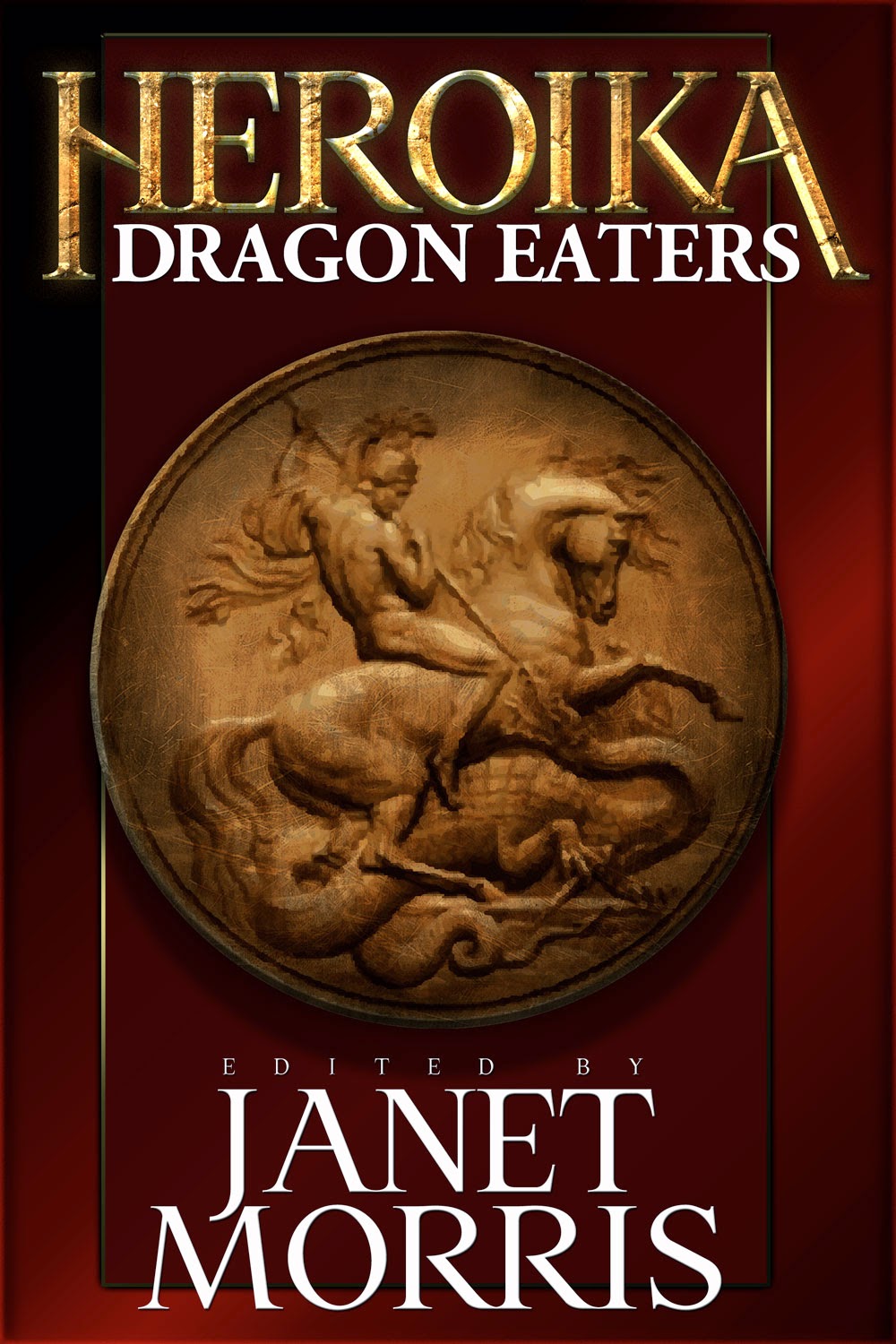
A Week with the Dragon Eaters – William Hiles

Character questions:
*Who are you? Captain Jackson Turner.
Why are you embarking on this quest? Revenge. For the killing of my men. For the devastation wrought by the beast.
Where are you from? (Tell us about it.) From Morgantown, Western Virginia. Though my family were farmers and shop keepers, I managed an appointment to West Point, where I was eventually commissioned as an officer in the United States Army.
*Tell us about dragons in your world. One exists. I don’t know why. I don’t know how. All I care about is killing it.
Do you have a family? I lost my family, a wife and child, to cholera many years ago.
Do you see yourself as a hero? What is a hero? No. What is a hero? That’s for others to decide. For me, it’s a matter of duty. To your men (or family). To yourself.
What is the technology level of your world? Mid-19th Century.
Author questions:
*Who are you? William Hiles
How do you define a hero? Someone who does what needs to be done, no matter the risk, for the benefit of others. Someone who performs a selfless action. Ordinary people who proceed with grace under extraordinary circumstances.
Why did you choose this world/era to write in? I’m a history nut. I love the challenges of bringing the past to life. I have a very special connection to military history, especially that of the United States.
Give us a couple of lines about your characters. Brave men who take a stand against an unimaginable horror, far beyond that of ordinary war. Former enemies, forced together for survival, who become brothers in a soul-searing crucible.
Heroika: The Dragon Eaters is a dark heroic fantasy – how do you define that genre? Dark heroic fantasy, to me, is a story of ordinary people, faced by extraordinary challenges, in a landscape that seemingly offers only obstacles or heartache. And yet despite this, these people rise to the challenges, overcome the obstacles, and ultimately succeed in bringing hope or peace or some fitting resolution to the story—even at the cost of their own lives.
How much research did you need for your story? Not much actually, having been a student of the era for many years.
Are you a plotter or a pantser? Mostly pantser. How a story ends is usually what I need to know before I begin, everything else is a journey to that end.
What other novels/short stories have you written? Early in my career I had quite a few stories in small press magazines. However, most of my output in recent years has been articles relating to my work (video games). I’m now getting back to writing more fiction.
What book(s) are you currently reading? War on the Run: The Epic Story of Robert Rogers and the Conquest of America’s First Frontier by John F. Ross
Tell us one unusual fact about yourself. I’ve kept a list of books I’ve read since I was 12 years old. I have over 1600 books on the list.
Tidbit:
Red Rain is set during and after a real American Civil War battle. The first land battle of the Civil War, in fact, fought in the vicinity of Philippi, Virginia (now West Virginia) on June 3. 1861. Writer Ambrose Bierce did serve in this battle.
Author website/blog: http://williamhiles.blogspot.com/
Twitter
Facebook: https://www.facebook.com/WJHiles
Amazon page:
Bio:
William Hiles, is a former magazine editor, game designer, writer and artist, living in Round Rock, Texas, with his wife, son, and a menagerie of pets. He likes to ramble on about history, cooking, art, and writing. Although he has been accused of living in the past, he does not write with a mere quill. It has to be an Australian Black Swan quill.

Subscribe to:
Posts (Atom)